
If You Keep Buying the Quick Fix, This Is Why
The Illusion of Relief We Keep Purchasing

This post unpacks the very human tendency to buy quick fixes: products and programs that promise transformation but often fall short. Not because we’re foolish, but because our brains are wired in ways that make those promises incredibly appealing.
As a therapist and mindset enthusiast, I’m always curiously observing my own behavioral patterns.
One of the most helpful thoughts I’ve acquired over the years is this:
“If I’m dealing with this, other people might be facing the same challenge.”
This thought comes from a nonjudgmental place. It connects me with the rest of humanity. It helps me have compassion for my own humanness and for others.
So let me share something honestly and vulnerably.
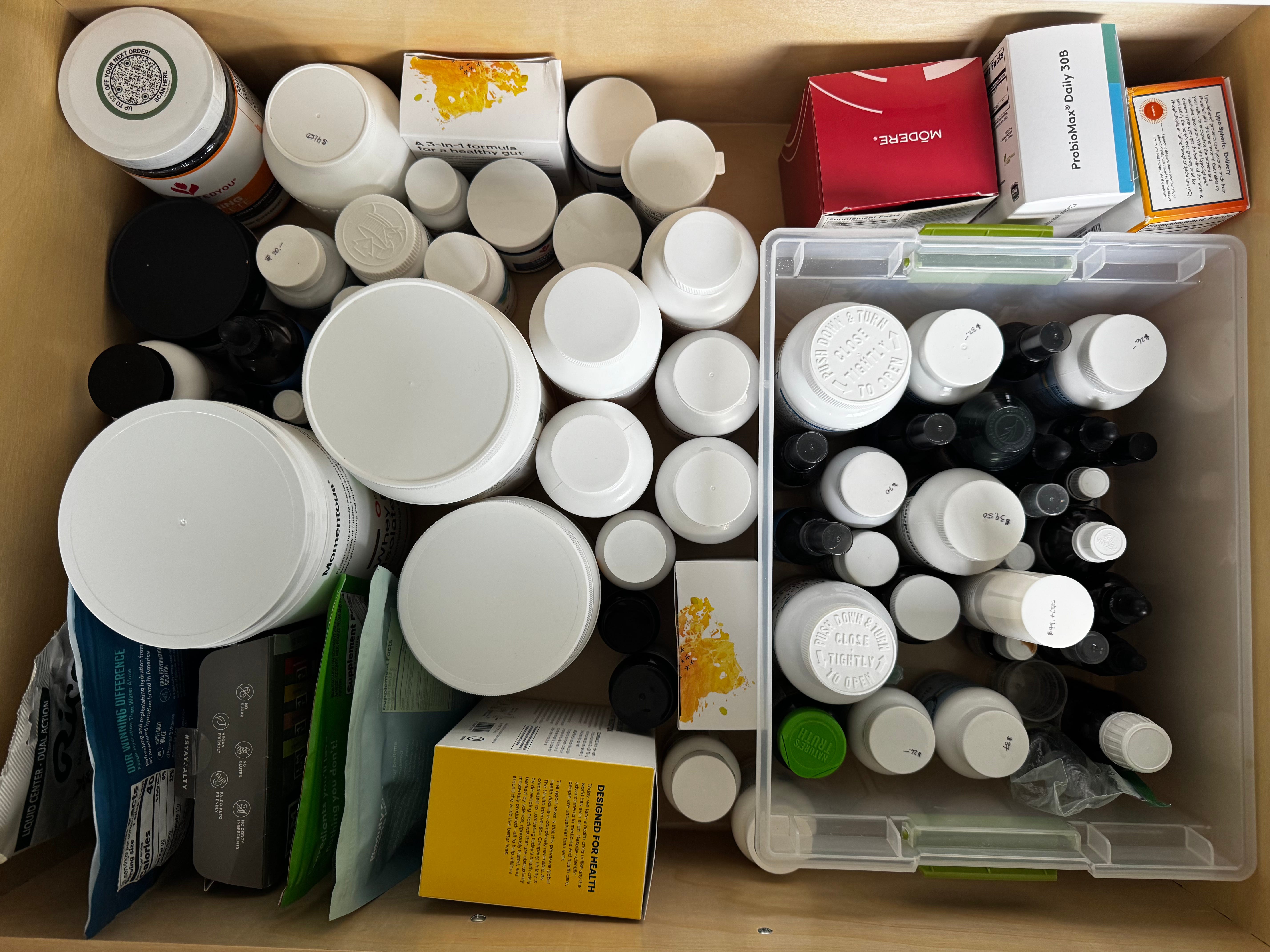
I had a giant drawer full of supplements.
I’ve spent a scary amount of money on bottles I never finish. This photo was taken after I purged expired products.
I’ve subscribed to:
Apps that promise weight loss in 30 days
Food delivery services that make healthy eating “easy and fun”
Courses, books, lessons, and programs that promise specific outcomes
You name it — I’ve probably tried it.
And when I’m really honest with myself?
My rational brain knows I rarely get the results I hoped for.
So why do I keep buying?
You’re Not Buying the Product. You’re Buying Relief.
There’s a more primitive part of my brain that wants immediate resolution.
When I buy the supplement, the program, or the plan, I feel something instantly:
Relief.
It feels like progress.
It feels like transformation is on its way.
It feels like I’ve solved the problem.
But what I actually purchased was an illusion, the imagination of a future self.
Marketing paints a picture so vivid that it blends with my own inner fantasy. In that moment, it’s hard to distinguish between rational thinking and a beautifully packaged promise.
And my brain loves that.
The Brain Is Wired for Efficiency — Not Growth
The human brain is designed for one primary goal:
Keep you safe. Keep you predictable. Keep you alive.
It does not prioritize growth.
Change requires:
Energy
Discomfort
Uncertainty
Repetition
And your brain does not love those things.
Quick-fix products fit perfectly into the brain’s model of efficiency because they promise:
Results
Minimal behavioral change
Conserved energy
Immediate emotional relief
Efficiency achieved. Brain at ease.
What Actually Moves the Needle (It’s Not Sexy)
In my own weight loss and body recomposition journey and in witnessing others’ journeys, what consistently works is surprisingly simple:
Eat for volume (prioritize protein)
Hydrate consistently
Walk 8,000–10,000 steps daily
Sleep 7+ hours
These habits:
Can be started today
Don’t require expensive purchases
Don’t depend on motivation
Compound over time
So why don’t we just do them?
Because Simple Feels Harder Than Complicated
Our brain loves to complicate things.
It creates overwhelm on purpose.
It whispers:
“Meal planning is too complicated.”
“You don’t have time to walk.”
“Sleeping more won’t make a difference.”
“This is too basic to work.”
Why?
Because overwhelm is a protection strategy.
If something feels overwhelming, we delay it.
If we delay it, we stay the same.
If we stay the same, we stay safe.
Overwhelm keeps us stuck, and it works every time.
Buying a quick-fix solution gives the brain a momentary sense that the goal is being handled… without requiring change.
Energy conserved. Problem “solved.” Dopamine delivered.
Can you relate?
That just means you have a normal human brain.
Where Do We Go From Here?
Keep it simple.
Strip your anchors down to just a handful of non-negotiables:
Eat for volume (building your meals around high-protein, high-fiber foods that let you eat a satisfying amount of food without overeating calories.)
Drink more water and be mindful of liquid calories that add up quickly.
Walk 8–10k steps (or start with 10 minutes after lunch and dinner)
Sleep 7+ hours even on weekends
Your brain will tell you these are too easy.
It will say, “This won’t change anything.”
Let your brain sit back and watch.
Let it take notes.
Because these behaviors compound quietly over time.
Release the Mental Weight
If the supplements on your shelf and the unfinished courses in your inbox are bullying you, release them.
You don’t need to think:
“I might use it someday.”
“I can’t waste the money.”
If they’re taking up mental space, see them as data you paid to collect.
That money wasn’t wasted.
It bought you awareness.
It showed you your humanness.
It helped you understand your brain a little better.
That perspective is valuable.
You’re not broken.
You’re not lazy.
You’re human.
And simple habits done consistently will always outperform expensive promises.
Tell your brain to sit back and watch.
Then start walking.